
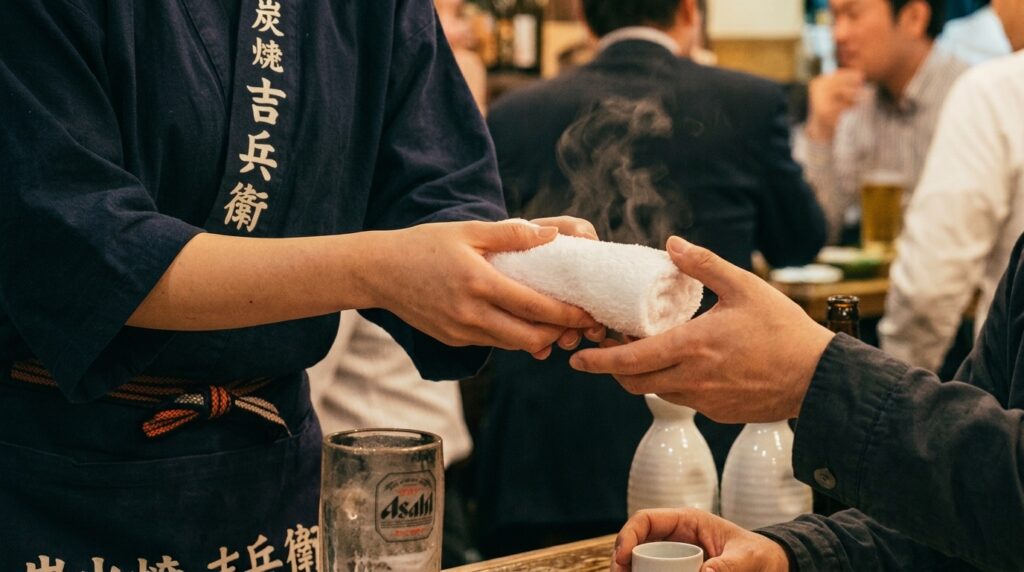
Before you’ve seen the menu, before you’ve ordered, before you have any real information about the place — the oshibori arrives. A small rolled towel, delivered on a tray or passed across the counter. In most izakayas, you get this within thirty seconds of sitting down.
What it’s made of tells you something.
メニューを見る前に、注文する前に、その店について何もわかっていない段階で——おしぼりが来る。小さく巻いたタオルが、トレーに乗って、あるいはカウンター越しに手渡される。たいていの居酒屋では、座って30秒以内に来る。
素材が、何かを教えてくれる。
Paper oshibori is the default. It costs almost nothing, requires no laundry, no preparation. You tear open the plastic, unfold it, use it, throw it away. Functional. Disposable. The owner has thought about efficiency.
Cloth oshibori is different. It has to be washed, dried, rolled, and warmed before service. Someone did that before you arrived. The cloth oshibori is evidence of preparation — of an owner who thought about the moment you’d sit down.
紙おしぼりがデフォルトだ。コストはほぼゼロで、洗濯も仕込みも要らない。プラスチックを破いて、広げて、使って、捨てる。機能的で使い捨て。店主は効率を考えている。
布おしぼりは違う。洗って、乾かして、巻いて、温めなければならない。あなたが来る前に、誰かがそれをやった。布おしぼりは準備の証拠だ——あなたが座る瞬間のことを考えた店主の。
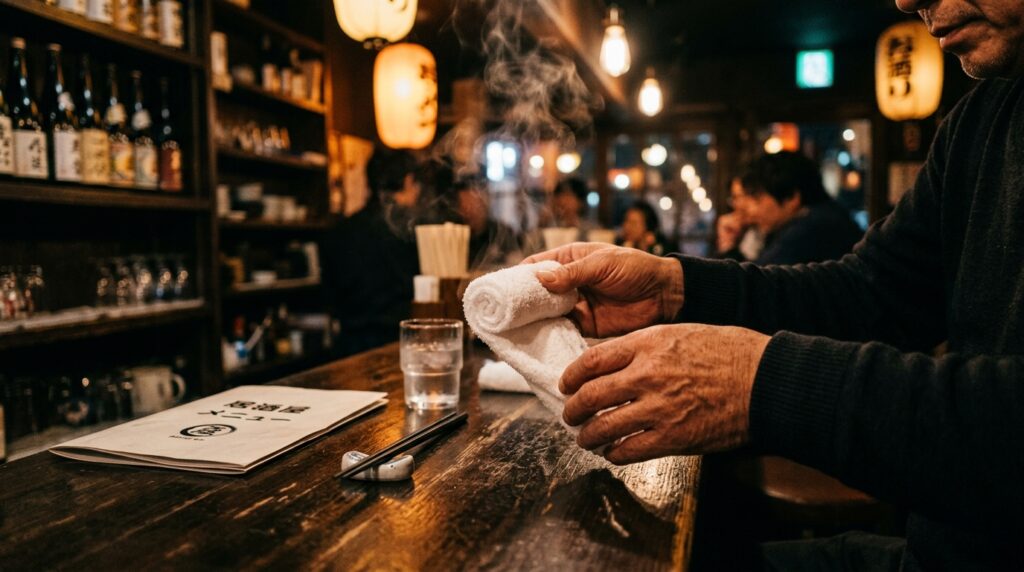
I’m not saying paper oshibori is a bad sign. Some good places use paper. But in twelve years, I can’t think of a cloth oshibori place that has disappointed me. The correlation is not perfect. But it’s high enough to act on.
The cloth oshibori is a small decision that costs the owner something — time, money, effort. That willingness to spend a little more, for something the customer will use for thirty seconds and forget, tells you about the way the place is run. The care in the small things usually extends to the large ones.
紙おしぼりが悪いサインだとは言っていない。良い店でも紙を使う。でも12年間、布おしぼりの店に失望した記憶がない。相関は完璧ではない。でも行動するには十分に高い。
布おしぼりは、店主に何かを負担させる小さな決断だ——時間、お金、手間。客が30秒使って忘れるものに少し余分にかける意志が、その店の運営の仕方を教えてくれる。小さなことへの丁寧さは、たいてい大きなことにも続く。
Eight times out of ten, the cloth oshibori is right. The other two — you sit down, look at the menu, order something, see how the owner moves. You figure it out.
But the cloth oshibori gives you a head start.
10回のうち8回、布おしぼりは正しい。残り2回は——座って、メニューを見て、何かを注文して、大将の動きを見る。そこで判断する。
でも布おしぼりは、出足を有利にしてくれる。





Leave a Reply